


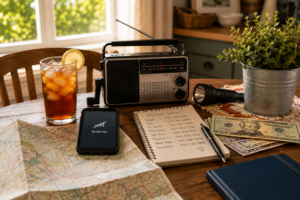
 September is National Preparedness Month, so naturally I couldn’t let it go by without talking about being prepared. But I’m not going to tell you to check your flashlights, rotate the food in your pantry, or make sure your emergency kit is stocked. We’ve talked about all that before.
Instead, I have a question for you. What would you do if suddenly you had no Internet? And before you answer, I’m giving you the same warning I gave Ian. No cheating. Put the phone down. I can see you reaching for it. I decided the best way to see how prepared we were for a loss of Internet and cell service was with a little quiz. Ian was my first victim—I mean, volunteer.
First question: What’s my cell phone number? He didn’t know. To be fair, I didn’t know his either. We call and text each other all the time, but neither of us actually dials the other’s number. We tap a name on a screen. That was a little unsettling. Ian didn’t seem particularly concerned until I pointed out that if he couldn’t access the contacts on his phone, he might not be able to reach me. That got his attention. He knows my number by heart now, and I know his.
So let’s see how you do.
Pepper’s No-Internet Preparedness Quiz
1 – Without looking at your phone, how many important phone numbers do you know?
Your spouse or partner? Children? Grandchildren? Doctor? Pharmacy? Veterinarian?
If the answer is not many, you’re in good company. Make a written list of the numbers you would most need in an emergency and keep it somewhere easy to find. And memorize the most important ones.
2 – Do you have a battery-powered or hand-crank radio?
If the Internet was down and television wasn’t available, how would you find out what was happening?
An old-fashioned radio suddenly doesn’t seem so old-fashioned when it’s your connection to local news, weather reports, and emergency information. Just make sure that if yours needs batteries, you actually have the batteries. A radio without batteries is a decorative object.
3 – Could you get where you needed to go without GPS?
I remember when we kept maps in the car, actual paper maps. The kind you unfolded easily and then spent twenty minutes trying to fold back the way they came. Today we ask our phones to tell us where to turn. That’s wonderfully convenient—until it isn’t available. Keeping a local and state map in the car isn’t a bad idea. You might never need it, but unlike your phone, it doesn’t require a signal.
4 – Is everything important stored in the cloud?
Insurance information. Emergency contacts. Medication lists. Important account information. Addresses. Digital storage is convenient, but consider keeping printed copies of essential information in a safe place. You don’t need to print your entire digital life. Just ask yourself: what information would I really need if I couldn’t get online? That’s what should have a paper backup.
5 – Do you keep some cash at home?
We tap cards. We swipe cards. We pay with phones. But electronic payment systems can go down. I’m not suggesting stuffing your mattress with hundred-dollar bills. Besides, that sounds lumpy and uncomfortable. But having enough cash available for necessities could come in handy if stores were temporarily unable to process electronic payments.
6 – Does your family have a plan if you can’t contact one another?
If calls and texts weren’t getting through, would everyone know what to do? Choose a meeting place. Decide who goes where. Make sure everyone knows the plan. It doesn’t need to be complicated. In fact, the simpler it is, the more likely everyone is to remember it.
7 – How much of your everyday life exists only online?
This one surprised me when I started thinking about it. Recipes. Calendars. Appointments. Addresses. Banking information. Instruction manuals. Contacts. I don’t think we realize how often we say, I’ll just look it up. So take a few minutes and think about the things you regularly look up online. Which ones would cause a real problem if you couldn’t access them for several days? Those are the ones worth having another way to access.
So… How Did You Do?
If you failed miserably, don’t feel bad. Ian did too. And I wasn’t exactly handing out gold stars for my own performance. That’s the whole point of National Preparedness Month. It isn’t about being ready for every possible disaster. I don’t think anyone can be. It’s about discovering the little holes in your preparedness before you need what isn’t there.
Technology makes our lives easier in countless ways, and I’m certainly not giving up my phone or computer. But I’ve realized something. A good prepper shouldn’t have only a Plan A.
Especially when Plan A needs Wi-Fi. So, here’s my challenge for you this month:
Put your phone down, take Pepper’s quiz with someone in your household, and see who does better. And no peeking at your contacts. Ian says that’s cheating. Of course, he knows that now because he already failed the test.
Until next time, stay prepped & prepared.
Pepper
💡 Pepper’s Prepper Tip
Write down the phone numbers of the people you’d most need to reach in an emergency and keep a copy somewhere safe. Then memorize at least one or two of the most important ones. Your phone is convenient—but only when you can use it.